


I’m not an expert. I’m a regular doing this along with you. I feel overwhelmed, too small to do anything that matters, powerless in the face of consolidated autocratic power consolidated in a short amount of time thanks to a long-game plan by a bunch of pasty broligarchs who have only a passing acquaintance with real human beings.
But time is passing and with each day that flys off the desk calendar, everything will become harder and the losses will grow greater and greater. Most of us have never known this kind of national upheaval in our lives1. It’s the kind of political chaos we observed from afar or studied in our history books.
When I was growing up in the 80s, the most salient news image I remember from the nightly news my parents watched was a Palestinian child, standing among ruins, throwing rocks at a tank. It seemed this image was on the national news just about every night. To an American six-year-old, it was a different planet that had no bearing on my existence.
I was living in New York on 9/11, Morningside Heights. I was getting ready for my part-time job (I was in grad school at the time) when 1010 WINS reported that a plane had crashed into the North Tower. Like most everyone else, I thought it was a tragic accident, a fluke. (We didn’t know it was a full-size passenger plane at first.) I turned on CNN.
My dad, a veteran TV journalist in Minnesota, happened to call me to chat. Keeping my eyes on the TV, I told him about the weird incident with the plane crashing into the WTC. We traded theories about what had happened—terrorist attack was not one of them—when, right before my eyes, a second plane crashed into the South Tower.
By then, we knew the first plane wasn’t an accident. No one needed to tell us this, of course. We just knew. But, like automatons, we continued our daily routines. Somehow, I got myself downstairs and waited at the bus stop, listening to 1010 WINS through my headphones. As I made my way to the back of the bus, a reporter broke in and said: “We’ve received a report that a plane has crashed into the Pentagon.”
I experienced something in that moment I had never experienced before. It was a feeling. A realization that we were under attack. A realization that no one was at the wheel. That no one was going to protect us, at least not in time to stop more suffering. Our government, which had brainwashed us since childhood into thinking it was the only thing standing between us and those scenes from the West Bank in the mid-80s, was useless. It had failed to protect us from three flying bombs, and counting.
I can’t really put words to that feeling, though I’d say it was a combination of terror, dread, a sense of abandonment, and a total lack of control. I got off the bus at my workplace, and, together with my boss and her husband, sat in their TV room and watched the towers fall.
That’s the feeling I have now. We’re not in control. There’s no one protecting us. And we’re under relentless attack. This time, unbelievably—and I mean that literally, I cannot quite believe I’m writing this—by our own government.
And just as on 9/11, I’m still getting dressed for work, taking my kids to soccer practice, following routines. I’m numb. I’m apprehensive. I’m filled with dread and doom. I’ve never been here before so I’m not sure what to do. I even gaslight myself sometimes—surely, it’s not a coup. Surely, they don’t want to intentionally destroy the economy in order to [insert Christo-Fascist Madlibs here]. Surely, they’re not slithering on their bellies in front of Putin, fucking over Ukraine, and surrendering body and soul to Russia.
But they are. And I know that. But what makes this dread and doom and apprehension different from that which I felt on 9/11 when we were attacked from without, is that it is infused by rage.
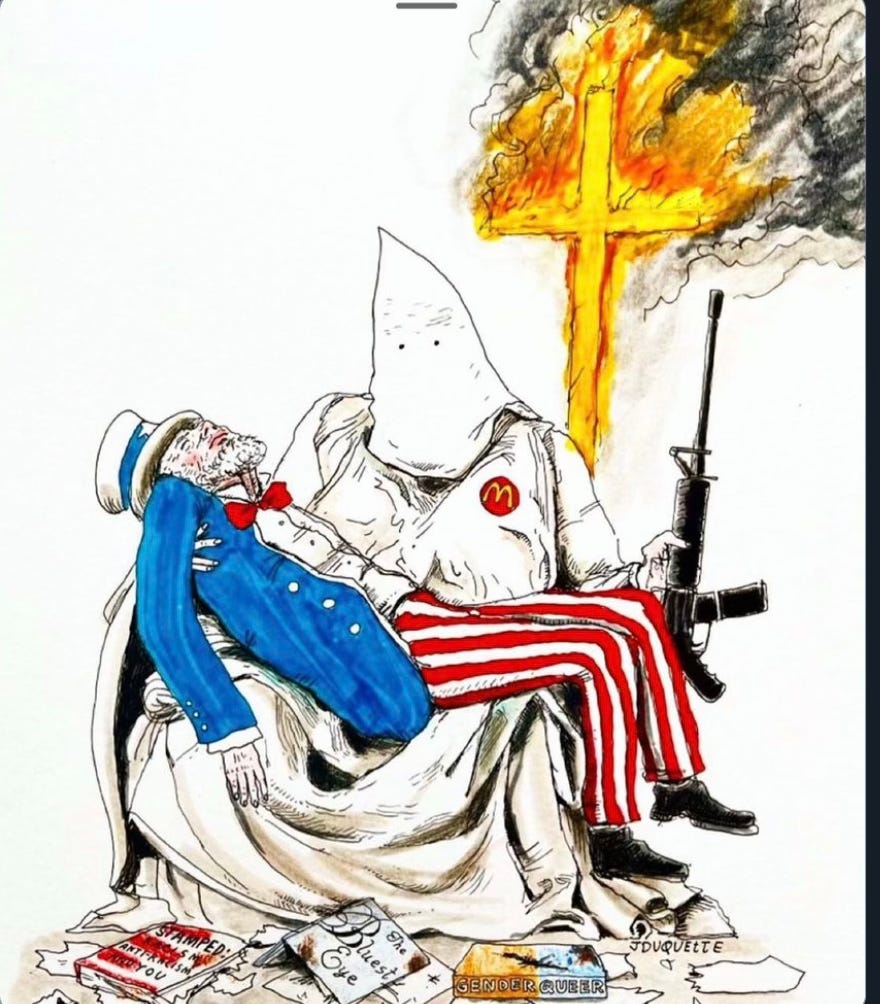
Apocalyptic rage. How dare these cosmically cringe losers think they can destroy our democracy. How dare Curtis “I’ve Never Known Human Love” Yarvin tell me and my children that I just have to learn to get over my “aversion” of dictators. How dare Elon Musk, an unelected visa cheat, stand in the Oval Office fielding questions like he was a president of the United States. How dare he occupy the same building as Lincoln and Kennedy.
Fear paralyzes. Turns us robotic or quiescent. But rage is a gift. It’s an engine. It’s uncomfortable for people to see and feel rage, because we’ve been socialized, mostly by the wealthy, to be “civil.” Protests are uncivil. Confronting our representatives for voting against our interests is rude. Making agitprop that references 1789 is a “deterioration of rhetoric.” Not mourning a dead healthcare CEO who enabled a company to commit social murder by overseeing the implementation of an AI-assisted claims denial with a known error rate of 90% is a moral affront.
But rage is the normal response to what is happening to us right now. It’s the rational response. Back when we lived in smaller social groups, these threats would’ve been dealt with swiftly and without much drama. Those who posed a threat to the group’s well-being were simply removed from the group.
Now we can’t shake off the parasites2 that have grown bloated and fat on our labor, our taxes, and our resources. No one is coming to help us. No one is at the wheel except the terrorists who’ve put the planes on a course that lands them straight into the towers. The only difference is that Elon Musk, Donald Trump, Curtis Yarvin, Stephen Miller, Jeff Bezos, Mark Zuckerberg, Peter Thiel, and Russell Vought don’t have the courage to pilot the planes themselves. Instead, they’re underground, far from public reach, remotely manning the planes as they crash into us. They are contemptible cowards.
Consider for a moment the fact that the 9/11 terrorists had more courage than the men I just mentioned, and you will understand why rage is the rational response.
Rage may be the key to breaking us out of normalcy bias, which is a kind of cognitive bias that leads us to underplay threats or underestimate the severity of a situation or outcome. It makes us slow to respond, even slower to act.
Author Amanda Ripley, who writes about the sociology of disasters, broke down the response pattern to threats into three parts: denial, deliberation, and “the decisive moment.”
Where are you right now? I think the majority of those of us who understand the danger we’re facing are still deliberating. But excessive deliberation can become dithering. I am arguing now for the decisive moment. There is no time to lose. And rage can be the engine that pushes us down the track toward that decisive moment.
So let me say it one more time: rage is an appropriate and rational response to current circumstances. Should you express this rage, either in person or on the page, you will undoubtedly have people “worried about you.” Ignore them. Frankly, I’m more worried about them for not being enraged.
But rage does not have to be chaotic. It is possible to harness its energy and use it for cool, deliberate, well-considered action. In the next couple days, I’ll be offering a few steps for making that final push out of normalcy bias, which may allow you to begin thinking clearly about what you can do to participate in the fight for our country’s very soul, should you want to participate.
Though we may have different political ideologies, I see that as a discussion for the rebuild, when we emerge from the rubble and figure out what kind of country we want to have.
“We have it in our power to begin the world over again.”
—Thomas Paine
BIPOC+ and LGBTQ+ Americans, of course, have ample experience with the weaponization of the government and state-sponsored violence.
I fully understand the historical context of this word and am using it with intention. As I’ve said elsewhere, I want to reclaim this word and use it instead to describe individuals who actually meet the criteria for the term, and American billionaires are illustrative examples.
“Frankly, I’m more worried about them for not being enraged.”
That’s what I keep saying!
Resistance is the glue that fills in all the spaces of my usual days from here on out.
But it’s worth it. I was making calls to representatives the other day and my 9 year old said, “Good job, mama, you’re changing the world.”
I’m trying. I’m trying.